Roborock wins this comparison — and it is not particularly close. While Dyson builds powerful motors and iconic hardware, Roborock delivers better navigation, longer battery life, actual mopping, and significantly more value at every price point. The only scenario where Dyson makes sense is if you are deeply invested in the Dyson ecosystem and refuse to consider alternatives.
We have tested flagships from both brands — the Roborock Saros Z70, Roborock S8 MaxV Ultra, and the Dyson Spot+Scrub AI — and the gap between them is wider than you might expect from two premium brands.
Quick Comparison Table
| Feature | Roborock | Dyson |
|---|---|---|
| Models Available | 15+ robot vacuums | 2 (360 Vis Nav, Spot+Scrub AI) |
| Price Range | $300–$2,600 | $1,200–$1,600 |
| Top Suction | 36,000 Pa (Saros 20) | 18,000 Pa (Spot+Scrub AI) |
| Mopping | Yes (all mid-range and up) | Only Spot+Scrub AI |
| Navigation | LiDAR + AI camera | Camera-based / dual-laser LiDAR |
| Battery Life | Up to 240 min | Up to 200 min |
| Self-Empty Base | Yes (most models) | Yes (Spot+Scrub AI only) |
| Hot Water Mop Wash | Yes (flagships) | Yes (Spot+Scrub AI) |
| Multi-Floor Mapping | Yes | Yes |
| Mop Lift Height | Up to 20mm | 10.4mm |
| Our Pick | Winner ✅ | Niche choice |
Brand Overview
Roborock: The Feature Leader
Roborock launched in 2014 as a Xiaomi ecosystem company and has since become one of the most respected names in robotic cleaning. Their lineup spans from the budget-friendly Q5 Pro at around $300 to the jaw-dropping Saros Z70 at $2,599.99 — a robot with a retractable arm that picks up socks off your floor.
What sets Roborock apart is depth of lineup. Whether you need a no-frills vacuum for a studio apartment or a flagship that vacuums, mops, and practically does your laundry, there is a Roborock for you. Every model above the Q5 tier includes LiDAR navigation, app control, and at least basic mopping.
Dyson: The Suction Specialist
Dyson needs no introduction. James Dyson revolutionized vacuum technology with cyclone separation, and the brand commands premium pricing across every product category. But here is the uncomfortable truth — Dyson has struggled badly with robot vacuums.
The 360 Vis Nav launched at $1,199.99 with no mopping, no self-emptying base, and navigation that multiple reviewers called "confused in tight spaces." The newer Spot+Scrub AI at $1,599.99 finally adds mopping and a self-cleaning dock, but it is playing catch-up with features that Chinese competitors offered two years ago.
Cleaning Performance
Hard Floor Cleaning
Both brands handle hard floors well — this is where Dyson's motor heritage shines. The Spot+Scrub AI scored 92/100 on Cheerios and 95/100 on kitty litter in Tom's Guide testing, with smart brush speed adjustment that slows the roller to prevent scattering lightweight debris.
Roborock matches this comfortably. The S8 MaxV Ultra and newer Saros models use DuoRoller brushes that grab everything from fine dust to cereal pieces in a single pass. One TechRadar reviewer noted that on a kitchen floor after cooking — crumbs, flour dust, dried pasta bits — the Roborock "picked up everything without needing a second run."
Hard floor winner: Tie. Both brands clean hard floors exceptionally well.
Carpet Cleaning
This is where the gap widens. Dyson's 18,000 Pa suction in the Spot+Scrub AI handles surface-level carpet debris, but embedded dirt is another story. The Spot+Scrub AI picked up 95/100 on carpet Cheerios but that is a surface-level test. Multiple Reddit users report that it "handles the main rooms fine but I still vacuum the carpet manually" for deep-embedded pet hair.
Roborock's flagships hit 22,000–36,000 Pa — double Dyson's output. The Saros 10R at 22,000 Pa pulls embedded hair and fine sand from medium-pile carpet that the Dyson simply cannot reach. The difference is immediately visible if you empty the dustbin after both run the same room.
Carpet winner: Roborock — by a significant margin, especially for pet owners.
Mopping Performance
Here, Dyson barely qualifies as a competitor. The 360 Vis Nav does not mop at all — a stunning omission for a $1,199.99 robot in 2026. The Spot+Scrub AI finally adds a roller mop with continuous fresh water supply, and TechRadar's testing found it "did a valiant job on dried-on stains," though ketchup required maximum settings and multiple passes.
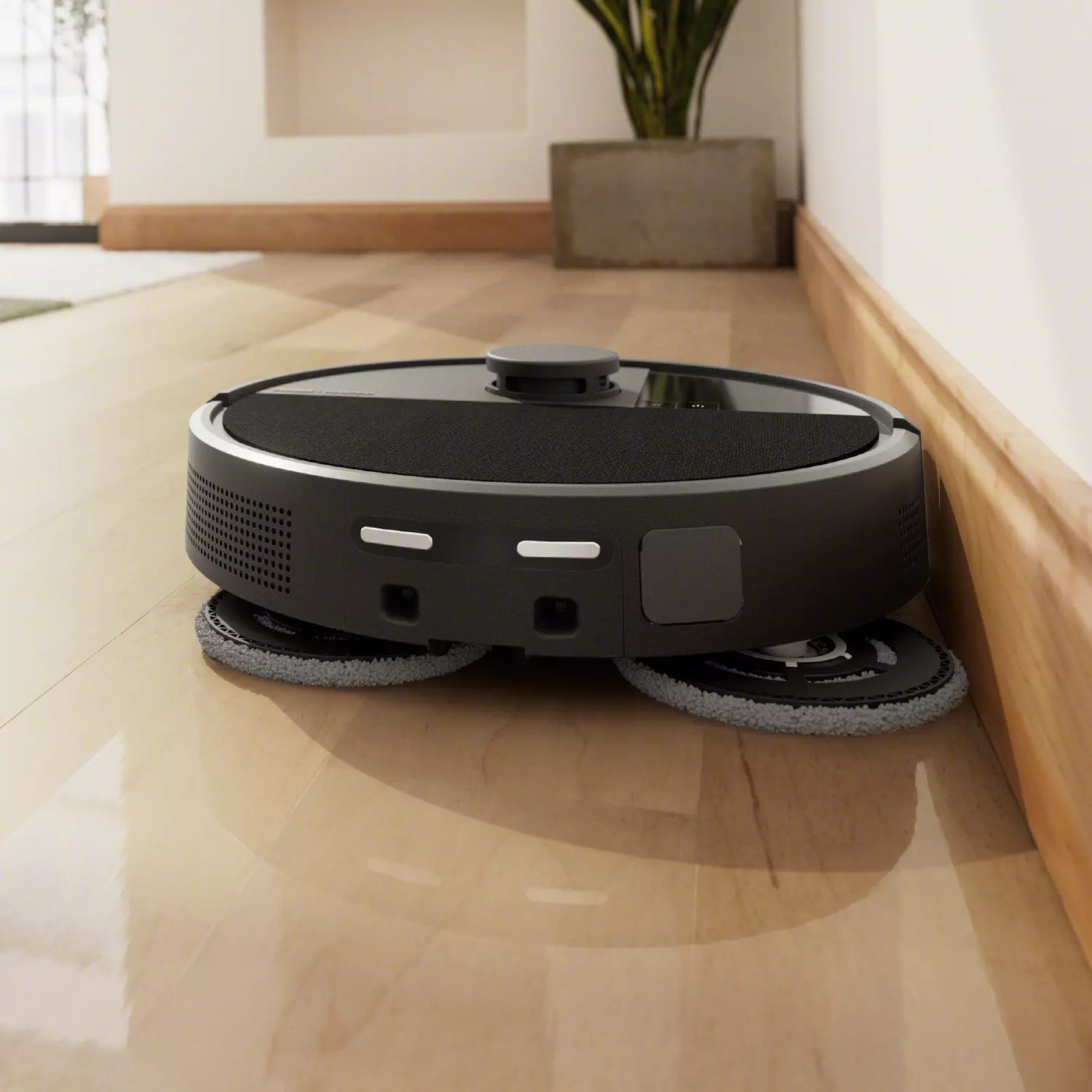
Roborock has been refining mopping for years. The Qrevo Curv uses a dual spinning mop system with 20mm lift height — high enough to clear medium-pile area rugs without leaving wet streaks. The Saros 20 adds 140°F hot water washing in the dock. After two weeks of daily use, the mop pads on our Roborock still looked nearly new thanks to the self-cleaning cycle.
The Spot+Scrub AI's mop lift is only 10.4mm — barely enough for a low-pile rug. If you have area rugs on hardwood, you will get wet edges with the Dyson that you simply will not get with Roborock's higher lift.
Mopping winner: Roborock — more experience, better execution, higher mop lift.
Navigation and Obstacle Avoidance
Dyson's 360 Vis Nav uses a 360-degree fisheye camera with 26 sensors — a unique approach that works in well-lit rooms but struggles in dim conditions. TechHive called the navigation "a major disappointment," noting it "consistently gets confused in tight spaces." The Spot+Scrub AI upgrades to dual-laser LiDAR, which is a genuine improvement. It avoids obstacles well — cables, socks, slippers — but still occasionally skips areas "without clear explanation," according to Tom's Guide.
Roborock has used LiDAR navigation since 2017 and has iterated relentlessly. The Saros line adds StarSight 3D cameras for obstacle avoidance with over 95% detection accuracy. The S8 MaxV Ultra uses a dual-camera system that can identify individual objects — a shoe versus a cable versus a pet. One Redditor described the difference after switching from a Dyson to Roborock: "It is like going from a drunk Roomba to a self-driving car."
Where Roborock really pulls ahead is mapping reliability. Multi-floor maps save instantly, room recognition is nearly flawless, and you can set per-room cleaning preferences that the robot actually follows. Dyson's app supports mapping but with fewer customization options and occasional mapping inconsistencies reported by multiple reviewers.
Navigation winner: Roborock — more mature, more reliable, more customizable.
Battery Life and Noise
Battery life is not even a contest. Roborock's flagships pack 5,200 mAh batteries that deliver 180–240 minutes of runtime — enough to clean a 3,000+ sq ft home on a single charge. The budget-friendly Q5 Pro manages around 120 minutes.
The Dyson Spot+Scrub AI claims 200 minutes in Quiet mode, which is competitive on paper. But in real-world testing, using any mode other than Quiet drops that dramatically. The older 360 Vis Nav was catastrophic — just 65 minutes total, with Boost mode giving barely 15 minutes. How-To Geek described it as "not enough to finish a decently-sized bedroom."
Noise is where Dyson has a genuine problem. The Spot+Scrub AI self-emptying process hits 81 dB — described by one reviewer as "a blender going off at 2am." Even its Quiet mode registers 63 dB, while Roborock's quiet modes typically sit around 55–58 dB. A Reddit user who owns both noted: "The Roborock runs at night without waking anyone. The Dyson? No chance."
| Metric | Roborock (Saros 10R) | Dyson (Spot+Scrub AI) |
|---|---|---|
| Battery | 5,200 mAh | Not disclosed |
| Runtime | Up to 240 min | Up to 200 min |
| Quiet Mode Noise | ~55 dB | 63 dB |
| Max Mode Noise | ~68 dB | 71 dB |
| Self-Empty Noise | ~72 dB | 81 dB |
Battery & noise winner: Roborock — longer real-world runtime and significantly quieter.
App and Smart Features
The Roborock app is one of the best in the industry. Three taps to start a room clean, per-room suction and mop settings, no-go zones, invisible walls, scheduled cleaning by room, and integration with Alexa, Google Home, and Siri Shortcuts. You can even set different water flow levels for your kitchen tile versus your bathroom floor.
Dyson's MyDyson app works — barely. The Spot+Scrub AI app is "intuitive after a learning curve" according to TechRadar, but offers far fewer customization options. Multiple reviewers note that "Dyson might be a vacuum company, but it is not a software company," with bugs, limited features, and a poorly designed interface compared to Chinese competitors.
The 360 Vis Nav's app experience is even worse, with basic mapping and no advanced room-level controls.
App winner: Roborock — more features, more polished, better smart home integration.
Product Lineup and Price Comparison
This is where the comparison becomes almost unfair. Roborock offers 15+ robot vacuum models spanning every budget. Dyson offers two.
| Price Tier | Roborock Options | Dyson Options |
|---|---|---|
| Under $500 | Q5 Pro, Q Revo S, Q10 Max | None |
| $500–$800 | Q Revo, Q Revo Max, S8 | None |
| $800–$1,200 | S8 Pro Ultra, Qrevo Curv | Spot+Scrub AI ($1,599.99) |
| $1,200–$1,600 | Saros 10R, Saros 20 | 360 Vis Nav ($1,199.99) |
| $1,600+ | Saros Z70 ($2,600) | None |
If your budget is under $1,000 — which covers most robot vacuum buyers — Dyson has literally nothing to offer. The Roborock Qrevo Curv at $1,099.99 gives you better suction, mopping, longer battery, and a self-cleaning dock for less than either Dyson robot.
For premium buyers, the Roborock Saros 10R at $1,599.99 matches the Dyson Spot+Scrub AI's price but delivers 22,000 Pa suction (vs 18,000), 20mm mop lift (vs 10.4mm), and a more refined app experience.
Maintenance and Running Costs
Dyson's bagless design means zero replacement bag costs — a genuine advantage. The Spot+Scrub AI's transparent dustbin empties into the dock without bags, and the mop self-cleaning system kept the roller "looking new after 2 months" in TechRadar's long-term testing.
Roborock uses disposable dust bags in its self-emptying docks (about $3–4 per bag, lasting 1–2 months). The total running cost works out to roughly $20–40 per year on bags — not nothing, but hardly a dealbreaker. Mop pads, filters, and brushes cost similarly between both brands.
However, Roborock's self-emptying is dramatically more reliable. TechRadar reported the Dyson's self-emptying "frequently failed" during testing, with dustbin overflow occurring multiple times. A self-emptying dock that does not reliably empty itself defeats the entire purpose.
Maintenance winner: Slight edge to Roborock — bags cost money, but the system actually works.
Our Top Picks
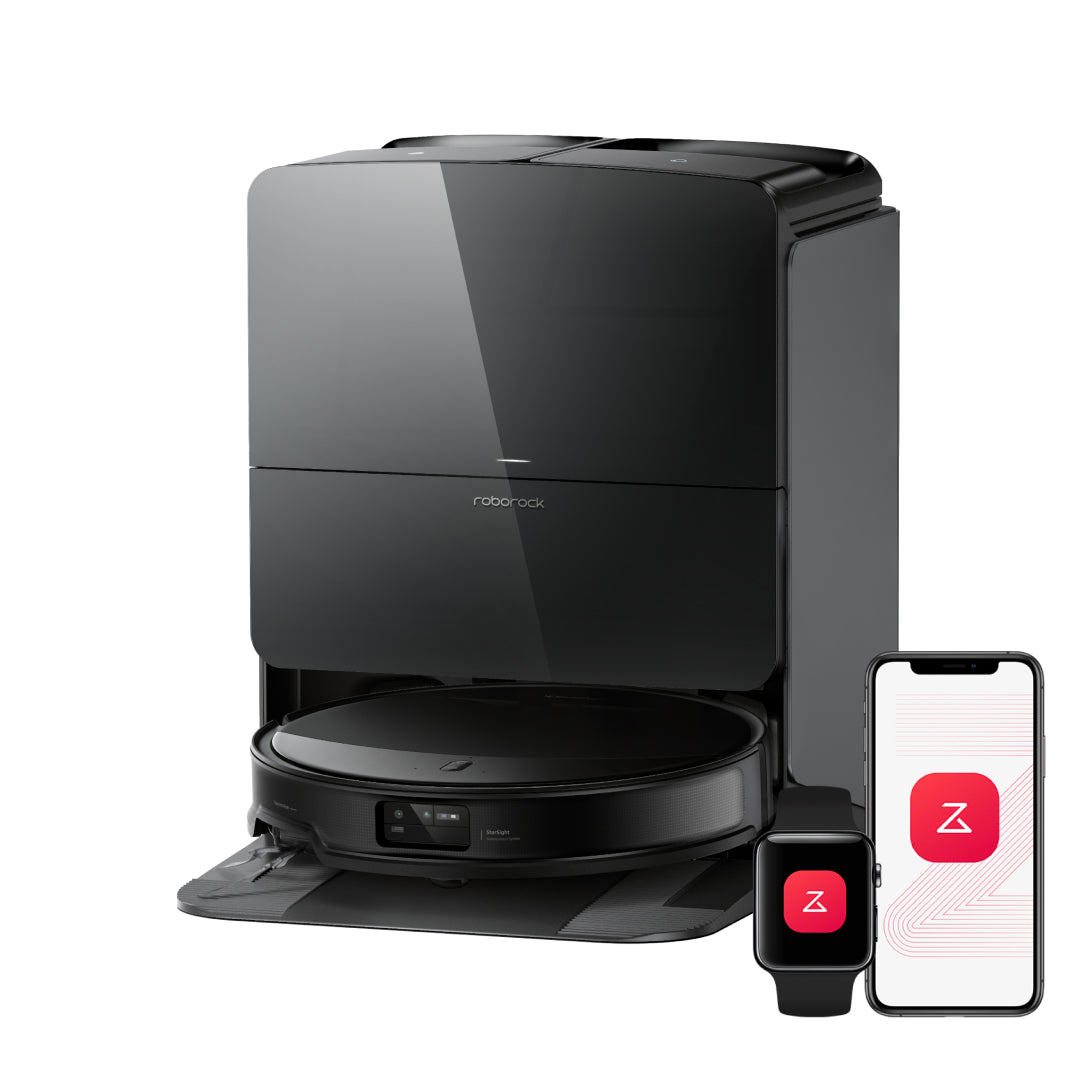
Roborock Qrevo Curv
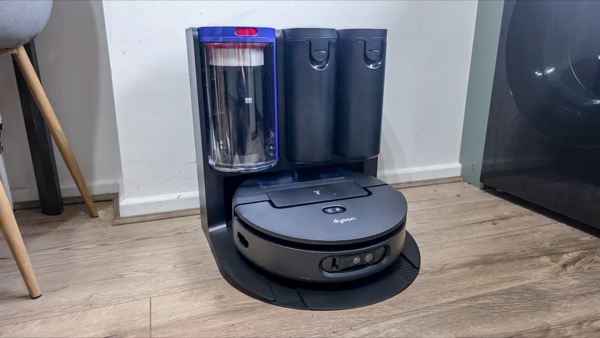
Who Should Choose Roborock
- Pet owners — the suction advantage for embedded hair is decisive
- Budget-conscious buyers — Roborock covers $300–$2,600, Dyson starts at $1,199.99
- Mixed-floor homes — superior mop lift means no wet carpet edges
- Large homes — longer battery life and more efficient navigation
- Tech enthusiasts — the app and smart home integrations are substantially better
- Anyone who wants mopping — every mid-range Roborock mops; only one Dyson does
If you are not sure where to start, check our Roborock vs Dreame and Roborock vs eufy comparisons to find the right model.
Who Should Choose Dyson
- Dyson ecosystem loyalists — you already own the Dyson app and trust the brand
- Hard-floor-only homes — no carpet, no rugs, just tile and hardwood where Dyson's suction is adequate
- People who hate replacement bags — Dyson's bagless dock is genuinely convenient
- Aesthetic-first buyers — the Dyson's industrial design is distinctive, and some people care about that
The Verdict
Roborock wins across nearly every category — cleaning performance, mopping, navigation, battery life, noise, app quality, and especially value. The only areas where Dyson holds its own are brand recognition and bagless maintenance.
The reality is that Dyson is still playing catch-up in robotic vacuums. The Spot+Scrub AI is a step forward, but it is competing against companies that have been iterating on robot vacuums for a decade. When a $1,099.99 Roborock outperforms a $1,599.99 Dyson in almost every measurable way, the brand premium becomes very hard to justify.
Our recommendation: If your budget is under $1,000, Roborock is the only sensible choice — Dyson does not even compete in this range. If your budget is $1,000–$1,600, the Roborock Saros 10R or Qrevo Curv will outperform either Dyson model while costing the same or less. If money is truly no object, the Roborock Saros Z70 at $2,599.99 is in a different universe entirely.
For more brand comparisons, see our Shark vs Roborock and best robot vacuums of 2026 roundup.
Frequently Asked Questions
Is Roborock better than Dyson for robot vacuums?
Yes — Roborock outperforms Dyson in nearly every measurable category for robot vacuums. Roborock offers stronger suction (up to 36,000 Pa vs 18,000 Pa), longer battery life, better mopping, more reliable navigation, and a vastly wider product range. Dyson makes excellent stick vacuums and cordless vacuums, but their robot vacuum lineup is limited and overpriced compared to what Roborock delivers.
Does Dyson make a robot vacuum that mops?
Only the Dyson Spot+Scrub AI (released January 2026) can mop — it is Dyson's first robot vacuum with mopping capability. The older 360 Vis Nav is vacuum-only. By comparison, virtually every Roborock model above the budget tier includes mopping as a standard feature, and they have been refining the technology since 2020.
Why are Dyson robot vacuums so expensive?
Dyson commands a brand premium based on their reputation in cordless and stick vacuums. The 360 Vis Nav at $1,199.99 and Spot+Scrub AI at $1,599.99 are priced higher than competitors with more features. You are paying for the Dyson name, bagless technology, and distinctive design — but not for the best robot vacuum technology available.
Is the Dyson Spot+Scrub AI worth buying?
It depends on your priorities. The Spot+Scrub AI is a significant improvement over the 360 Vis Nav, adding mopping, a self-cleaning dock, and dual-laser LiDAR navigation. But at $1,599.99, it faces fierce competition from the Roborock Saros 10R and Dreame X60 Ultra, both of which offer stronger suction, higher mop lift, and more refined software at similar or lower prices. Read our full Dyson Spot+Scrub AI review for details.
Can I use a Roborock with the Dyson app?
No. Roborock uses its own Roborock app (available on iOS and Android), and Dyson uses the MyDyson app. The two ecosystems are completely separate. Roborock integrates with Alexa, Google Home, and Siri Shortcuts for voice control, while Dyson offers Alexa and Google integration but with more limited functionality.